Electrochemical cells wear out. Light does not.
Most fixed and portable toxic-gas detectors use electrochemical (EC) cells. The chemistry is used up, so the cell is a consumable. For ammonia that is about one year of life, and about six months where the air carries a few ppm all the time (GfG application note AP1002). EC cells also cross-react: an NH₃ cell can read 35 ppm on 25 ppm H₂S, and its signal swings about ±40 % over −20…+50 °C (mPower TA-Note 4).
Electrochemical cell
- Small, cheap, low power
- Consumed by use; NH₃ cells ~1 year
- Cross-sensitivity, temperature drift
- Frequent bump tests and swaps
NDIR
- Stable, no consumables (our core, see IR·OEM)
- Broadband light, filter selects the band
- Not selective or sensitive enough for ppm-level NH₃, H₂S, HCN in a small can
TDLAS (laser)
- One narrow laser line per gas: selective, drift-checkable
- Built from discrete lasers, optics and long cells
- Analyzer size and cost, not a sensor part

- 01 · Laser. An InP laser tuned across one absorption line of the target gas, in the near-infrared (1.51–1.58 µm). One laser technology covers all three toxic gases.
- 02 · Spiral. A long, low-loss waveguide coiled on a few mm². Gas that diffuses through the inlet absorbs a little of the light guided along it.
- 03 · Detector. A photodetector measures how much of the line is missing. More gas, deeper line.
- 04 · Firmware. Calibration and drift correction turn the line depth into ppm. The line itself is the reference, so zero can be checked without a gas bottle (target behaviour, to be shown on the bench).
- 05 · Output. In the drop-in format, a current that looks like an EC cell to the existing electronics, plus I²C / UART for the full reading and diagnostics.
H₂S is the exception: its near-infrared lines are too weak for direct absorption at alarm levels. Our route for H₂S is the same chip laser with a small photoacoustic / light-induced thermoelastic (LITES) cell; about 300 ppb has been shown in a 6×4×4 cm cell (Chen et al. 2023) published lab work.
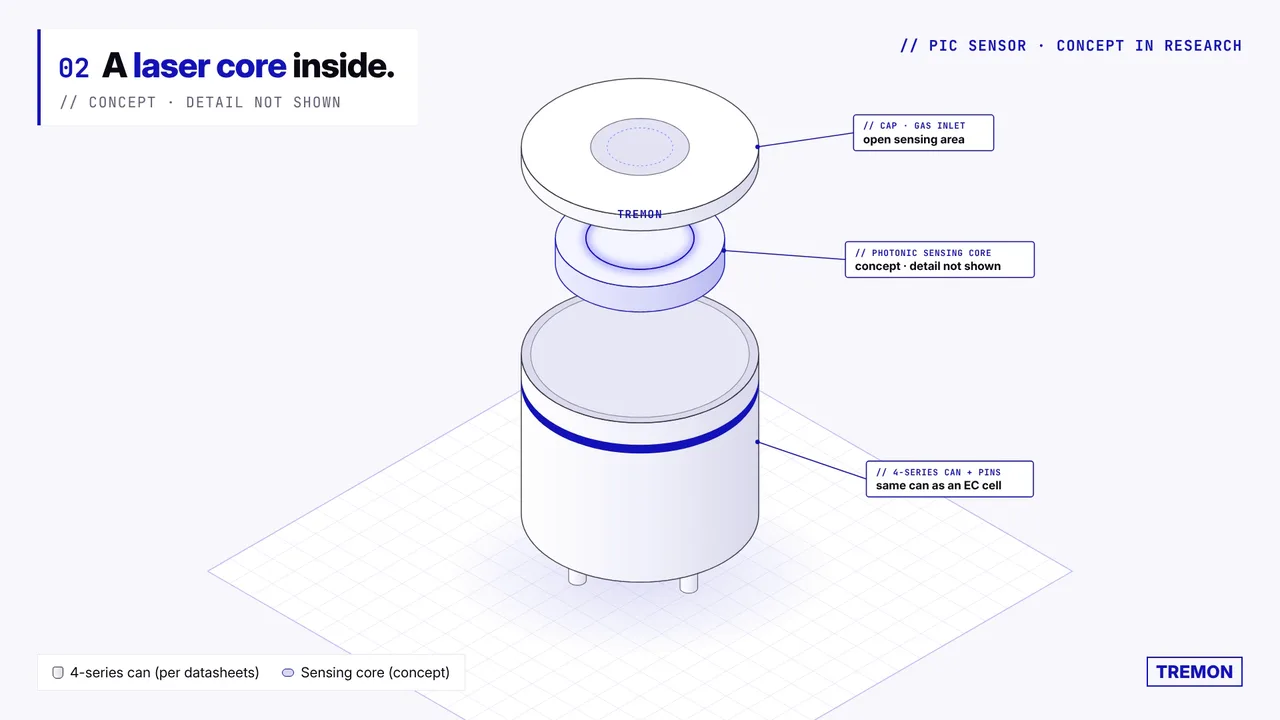
Inside the can
Exploded view of the module concept. The can and pin positions follow the 4-series datasheets; the stack inside is our design proposal, not a built part. No cooler (TEC): the laser is tuned by current and temperature.
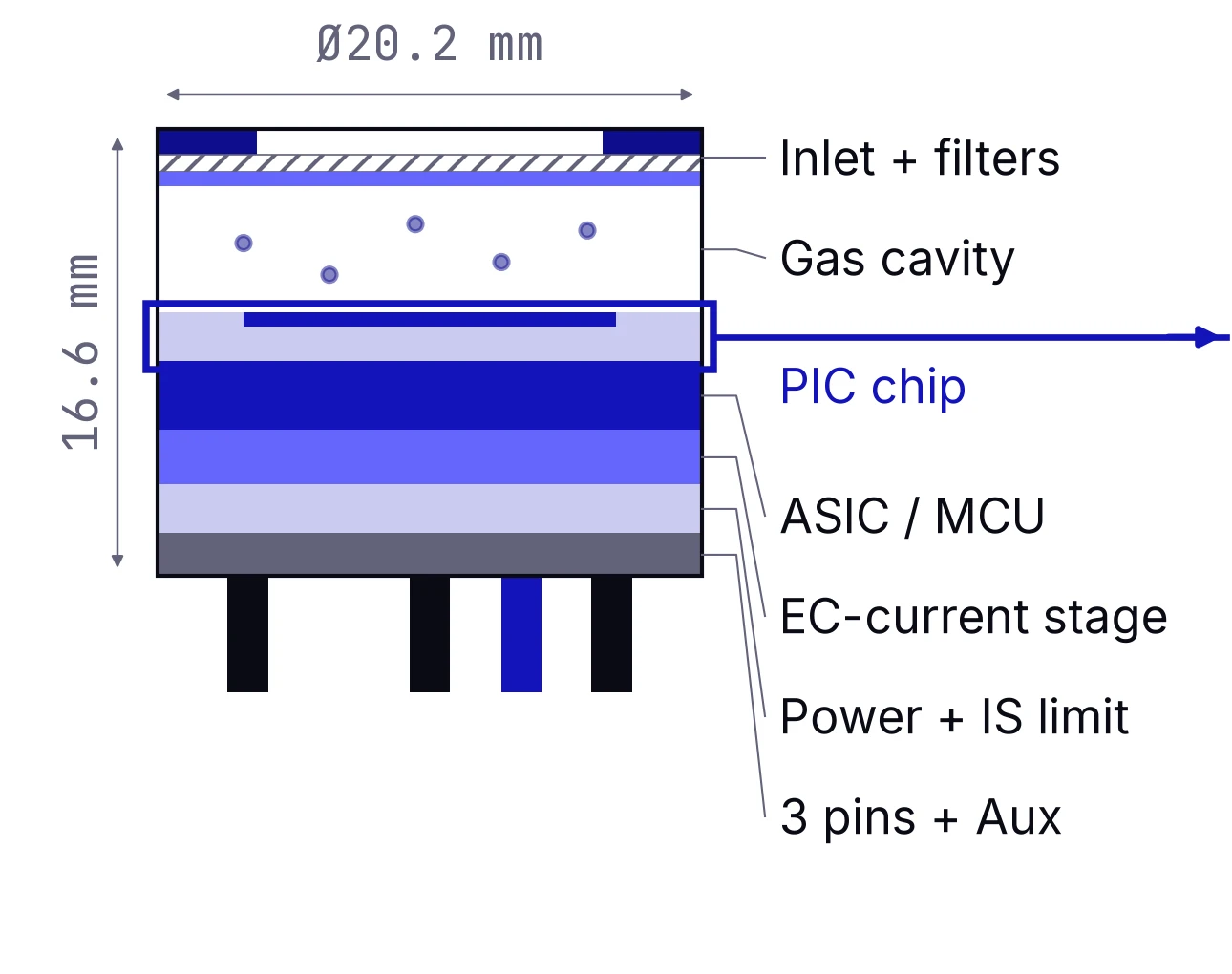
Layers, top to bottom
- Cap · gas inlet: open sensing area, as on EC cells.
- Dust filter (sintered or PTFE mesh) and hydrophobic ePTFE membrane (water barrier).
- Gas cavity: a shallow volume over the chip; its size sets the response time.
- PIC chip on a ceramic carrier: laser, spiral waveguide, signal and reference detectors, temperature sensor.
- ASIC / MCU board: laser drive, detector readout, calibration memory, self-test.
- EC-emulation + power: EC-style current on W/R/C, supply regulation, protection.
- 4-series can + header: Ø20.2 × 16.6 mm, W, R, C and Aux pins on a 13.5 mm circle.
All concept. The H₂S photoacoustic cell would be an extra layer in an H₂S variant and is not shown.
Nothing on this page is a measured product specification yet. Each number is labelled: model estimate (Tremon calculation from HITRAN line data at an assumed noise floor), target (pass criterion we set for the bench and first chip), standard / datasheet (published values we design to), or published lab work (other groups).
| Item | Value | Status |
|---|---|---|
| NH₃ line | 1531.68 nm (vacuum; H₂O-free) · alternatives 1513.86 nm (≈2.5× stronger, H₂O-adjacent) and 1512.24 nm | standard / datasheet HITRAN |
| NH₃ detection limit | ~0.5–5 ppm on chip (L_eff ~3–30 cm) at 1513.86 nm, ≈2.5× higher at 1531.68 nm · ~0.15 ppm only in a 1 m cell / multipass | model estimate noise-equivalent absorbance 1e-5 |
| HCN line · detection limit | 1.528 µm · ~0.6–6 ppm on chip (L_eff ~3–30 cm); the 0.9 ppm TWA only near the top of that range · ~0.19 ppm in a 1 m cell / multipass | model estimate |
| H₂S | ~1.578 µm; direct absorption does not reach 5 ppm → photoacoustic / LITES route | model estimate published lab work |
| Bench gate: detection limit at 10 s | ≤ ½ TWA: NH₃ 10 ppm · H₂S 2.5 ppm · HCN 0.45 ppm | target |
| Response time | t90 ≤ 150 s (standard limit); aim t90 ≤ 30 s | standard / datasheet target EN 45544 / IEC 62990-1 |
| Temperature | zero drift ≤ detection limit over −20…+55 °C | target |
| Format | 4-series can, Ø 20.2 mm × 16.6 mm, pins on 13.5 mm circle | concept dimensions per 4-series datasheets |
| Outputs | EC-compatible current on W/R/C + I²C / UART on pads | concept |
| Power | ~20–30 mW via one supply contact (EC sockets carry no power) | model estimate |
| Consumables | none in the light path | concept |
Same can, same pins: design it in, keep your product
We work with OEMs, not with end users. The aim is a sensor that fits your existing detector platform with as little redesign as possible.
Same footprint, one extra pin
What a swap would look like on a board that has the fourth contact. Honest version: same can and the same three signal pins as a 4-series toxic cell, plus one supply pin in the Aux position. EC sockets carry no power, so the board must provide that contact.

| Cell (4-series) | Can | Pins | vs Tremon PIC module | Source |
|---|---|---|---|---|
| City 4CF+ (CO) | Ø20.2 × 16.6 mm | 3: W, R, C · Ø1.55 on 13.5 mm circle | W R C match · no Aux socket → board must add the supply contact | datasheet |
| City 4HN (HCN) | 4-series can | 3: sensing, reference, counter · Ø1.5 | W R C match · supply contact needed | datasheet |
| Honeywell 4NH3LL-100 (NH₃) | Ø20.2 mm, 4-series | 3: W, R, C · Ø1.5 on 13.5 mm circle | W R C match · supply contact needed | datasheet |
| SGX-4NH3 (NH₃) | 4-series can | 3: W, R, C · Ø1.5 on 13.5 mm circle | W R C match · supply contact needed | datasheet |
| Membrapor NH3/MR-100 (NH₃) | "Miniature" housing = 4-series | 3-electrode | W R C expected to match (pin drawing not checked) | datasheet |
| Alphasense CO-A4 / A4+ (CO) | Ø20.2 × 16.5 mm | 4: W, R, C + Aux electrode · Ø1.5 on 13.5 mm circle · A4+ adds I²C pads | W R C match · the Aux socket exists, but it reads an electrode, so the board must re-route it to a 3.0–3.6 V supply | datasheet |
| City 4OXV (O₂) | Ø20.4 × 16.6 mm | 2: anode, cathode + plastic locating pin | different pin set (2-electrode galvanic) · not a swap target | datasheet |
Plan, not commitments. Today we are at research stage. NH₃ first, then HCN and H₂S.
- Done / ongoing: expert interviews (ongoing), line selection from HITRAN, detection-limit model, interface concept for the 4-series can.
- Not done yet: no chip has been made; no gas has been measured with it; no field data; no certification.
- Known hard parts: HCN needs a long effective path (~30 cm L_eff on chip) for its exposure limit; H₂S needs the photoacoustic route; water and CO₂/CH₄ lines near 1.57–1.58 µm must be rejected.
- What we know well: NDIR gas sensing. Our own NDIR products, the base of our custom R&D work, are on the NDIR R&D page.
Is the PIC sensor a product?
Which gases does it target?
Who is it for?
How can we take part?
Let's research this together
We are researching a near-infrared photonic chip for NH₃, H₂S and HCN safety, meant to sit where an electrochemical cell sits today. We want to shape it with detector makers and the people who use their detectors.
- Gas-detector makers (OEMs) using toxic-gas cells today
- Gas-safety experts and end users of NH₃, H₂S or HCN detection
- Test, certification and calibration labs
- Photonics and gas-sensing research groups
- Expert interview — 30 minutes on how you handle toxic-gas detection (NH₃, H₂S, HCN) today, and where a new kind of sensor would — or would not — help.
- Feasibility study or pilot — We scope your use case together — your gas, site or system — and test whether the concept fits. A pilot follows once there is hardware to put on site.
- Joint research or grant consortium — Partner with us in a joint research project or an EU or national grant consortium on near-infrared chip sensing of NH₃, H₂S and HCN.
// research stage · not a product · sales@tremon.nl